Bug Hunting in Retro Games
The bugs that went undetected, or that everyone accepted as intended, are the interesting ones, and retro games have a lot of them. An emulator with good instrumentation lets an agent test many configurations and compare the results, which makes it practical to search for these bugs. The example: a Parasol Stars bug where the second controller port controls whether enemies can fly through walls.

Bugs fascinate me, especially the ones that nobody detected, or that everyone took to be intended. Some of them stay in shipped software for years, and people learn them as normal behavior. Finding one of those decades later has always been one of my favorite things.
Retro games are a good place to look for these bugs. At that time, it was easy to make a bug like this by accident. Most developers wrote in assembly, and they had few of the tools that we use now to find bugs, such as static analysis and test automation. There are also thousands of these games, and emulators let us run and inspect them.
A shipped cartridge did not get online updates, but it was not always the last version either. Some games got cartridge revisions that fixed bugs, and sometimes a revision broke other things or changed a feature. Releases for different regions were often built from different snapshots of the code. I think we have only begun to scratch the surface in finding this stuff. Speedrunners have done this kind of work for a long time: they look for ways to break a game so that they can finish it faster or skip whole sections.
Some of what shipped stayed hidden for a long time. Every cartridge of GoldenEye 007 (Nintendo 64, 1997) contains a ZX Spectrum emulator with ten of Rare’s Spectrum games. Rare made it as an experiment and disabled it, but did not remove it, and players found it in 2012, 15 years after release. The game also still contains a character select screen for the earlier Bond actors, which you can only reach with a cheat device.
Developers also put in button codes and debug features that they never disclosed, or that they forgot about. Homefront: The Revolution (2016) contains a full port of TimeSplitters 2 that a code unlocks. In 2021, the programmer who added it said that the code was lost with his notebook. Four days later, a player who had kept the code from an old message posted it, while a modder was already reverse-engineering the game’s menus to find it. In Alien Resurrection (PlayStation, 2000), a programmer added a code that lets you swap in another disc without a reset. It was a test, and he did not tell the other developers or Sony. He revealed it in 2023, 23 years later.
This is the part that gets me most excited. Every game that shipped is a snapshot of code that somebody wrote under a deadline, and most of that code has probably never been read by anyone outside the team that wrote it. Even with sites like The Cutting Room Floor documenting so much, there are probably debug menus, cheats, unused features and bugs in thousands of games that nobody has found yet. Add every revision and every regional release, and the pile only gets bigger.
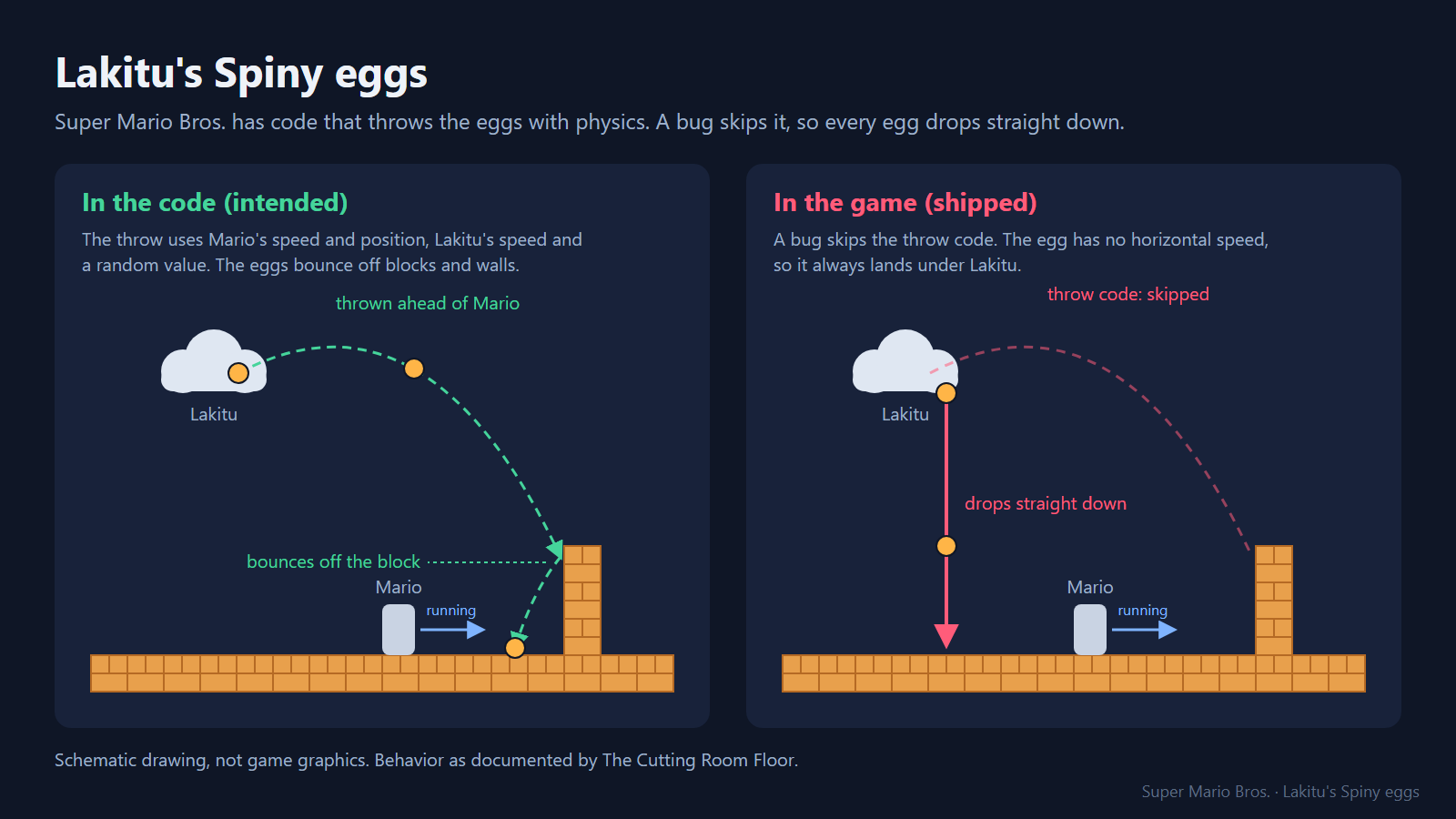
Some well-known behaviors started as bugs. In Super Mario Bros., Lakitu was supposed to throw Spiny eggs with some physics: the throw depended on Mario’s speed and position, and the eggs bounced off walls. A bug makes the eggs drop straight down. For decades, players knew that as normal Lakitu behavior. In Street Fighter II, you can cancel a normal attack into a special move. This came from code that made special-move inputs easier. Capcom saw it during development and kept it.
Bugs that nobody noticed are hard to find, because no document shows what the developers intended. The only evidence is in the code, where two parts of the code disagree. Often the bug occurs in one configuration only: one controller instead of two, a multitap connected or not, a different region, different timing. To find one, you must know the game well enough to see that something is different. Then you must test each configuration and compare the results. A person can do this for one or two theories, but it is slow work.
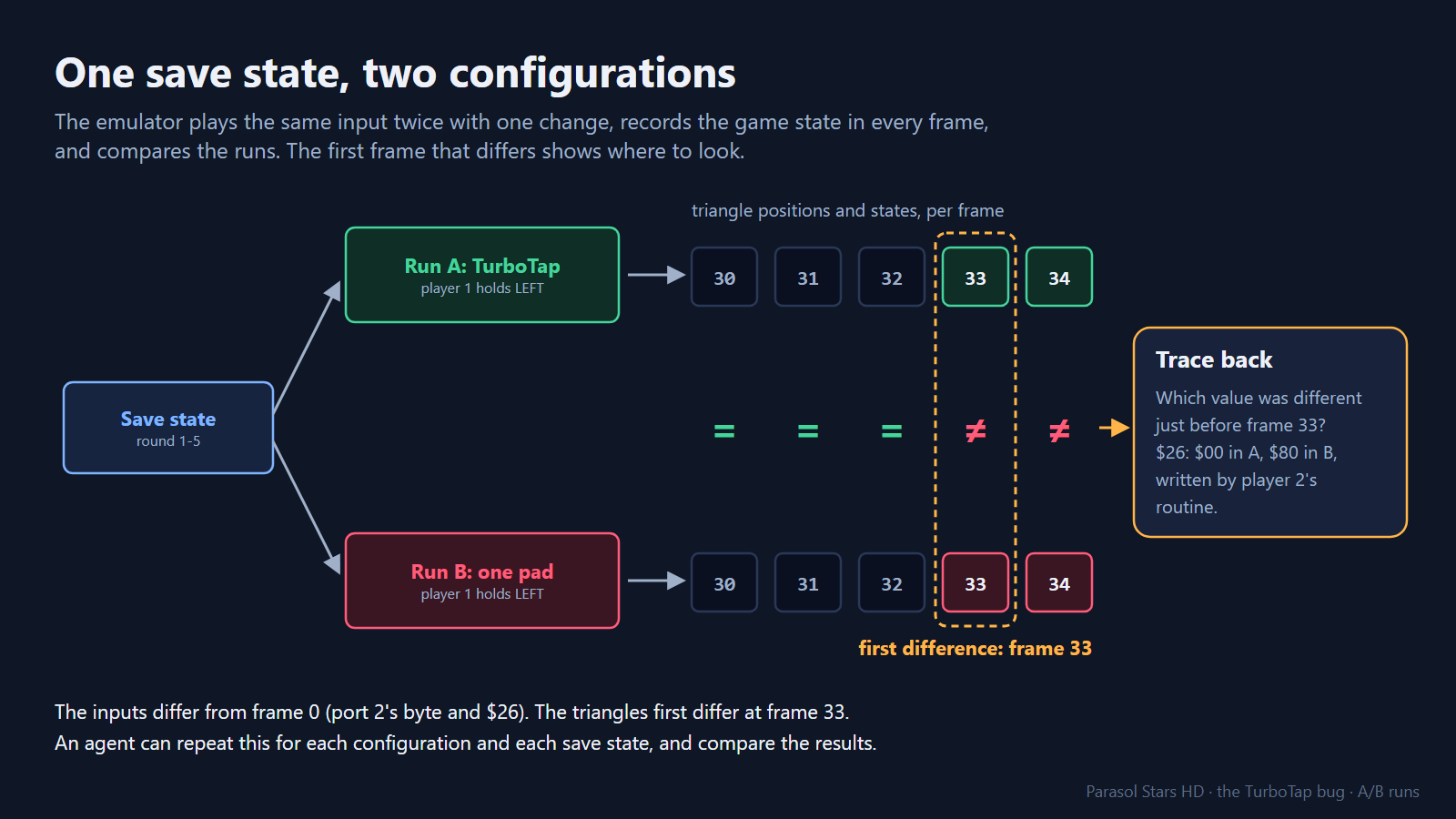
An emulator with good instrumentation makes this easier. You can save a state, play the same input in different configurations, record the RAM in every frame, and compare the runs. An agent can do this for many configurations and many save states, and it does not get tired of comparing memory dumps. With an agent, you can search for these bugs before you have a theory.
The example below is from a remake project of mine. I saw a difference in difficulty, and an agent found the cause.
The project
I am remaking Parasol Stars (Taito, PC Engine, 1991) in Godot, and the remake must behave like the original. Agents read the original HuC6280 code and write the same logic in GDScript. A lock-step harness then runs the remake and the original ROM side by side in an emulator and compares the game state in every frame.
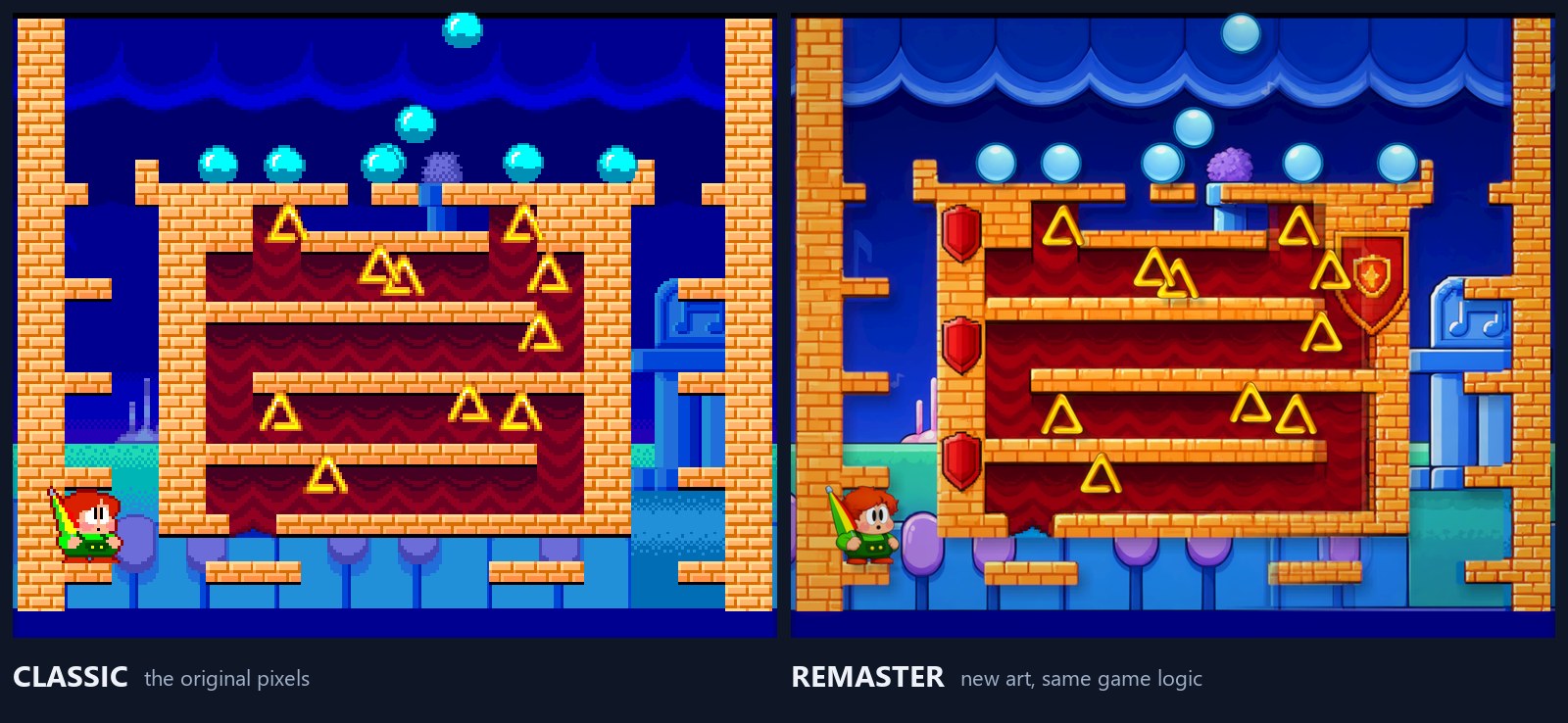
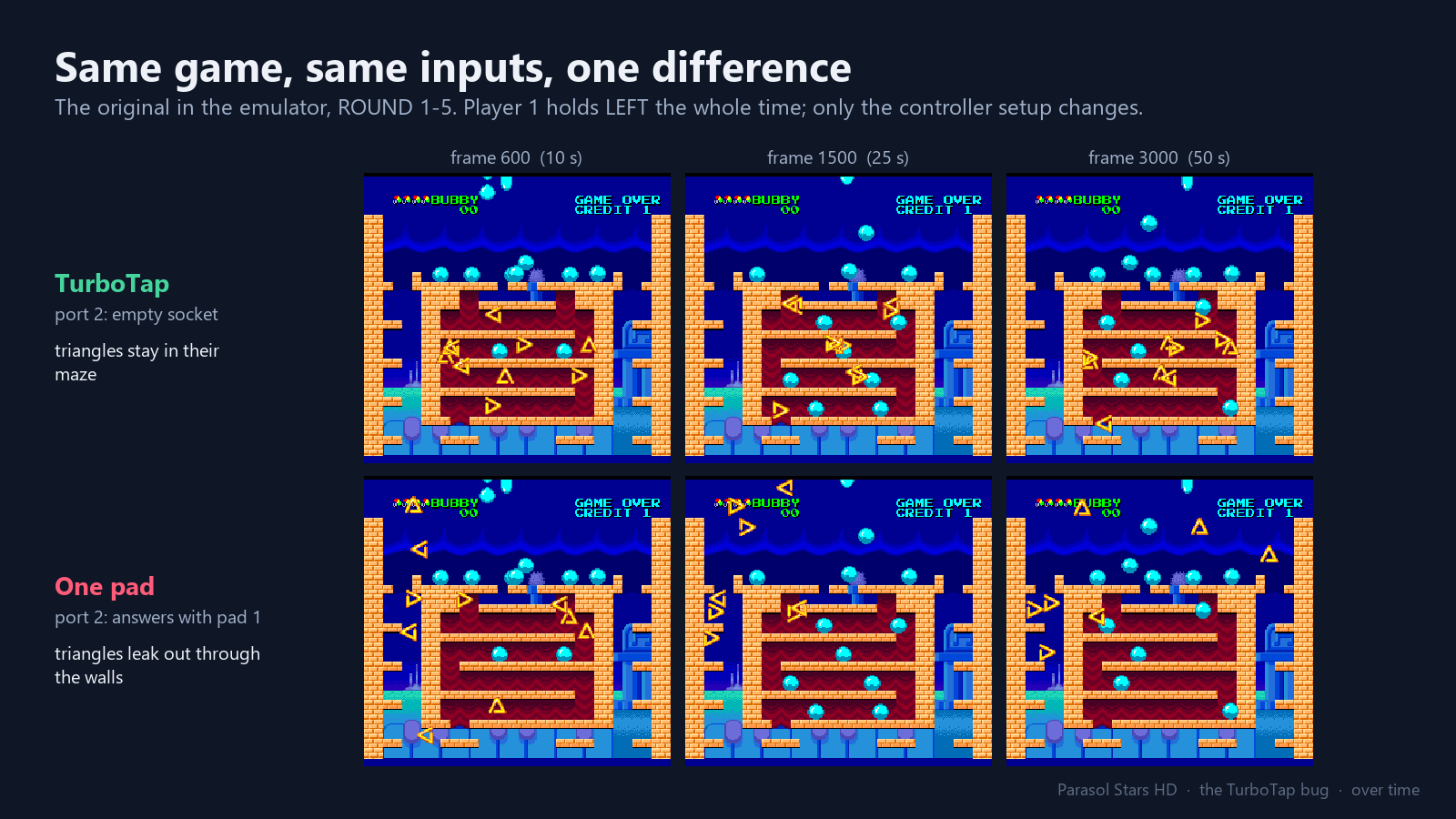
Round 1-5 is a brick maze with ten triangle enemies that fly inside it. There are four water dispensers on the roof. The room is designed for one method: wait until the triangles are together, then flood the maze. In the remake, the triangles went out through the walls and chased me, and a flood never cleared the room. I did not remember the original being this hard.
I played the original in an emulator. The triangles stayed in the maze, except for some short trips through the maze’s openings. One flood from the roof removed all of them.
The first theory was that the remake had the wrong enemy speeds. The agent measured the player and the triangles in both versions. The speeds were the same to the sub-pixel: 1 pixel per frame, and 2 when the triangles are angry.
The difference was the controller configuration. The remake was built against an emulator harness with no multitap, so it used the behavior of one pad connected directly to the console. My emulator had the multitap enabled. Nobody had compared the two configurations, and the game behaves differently in each one.
The hardware
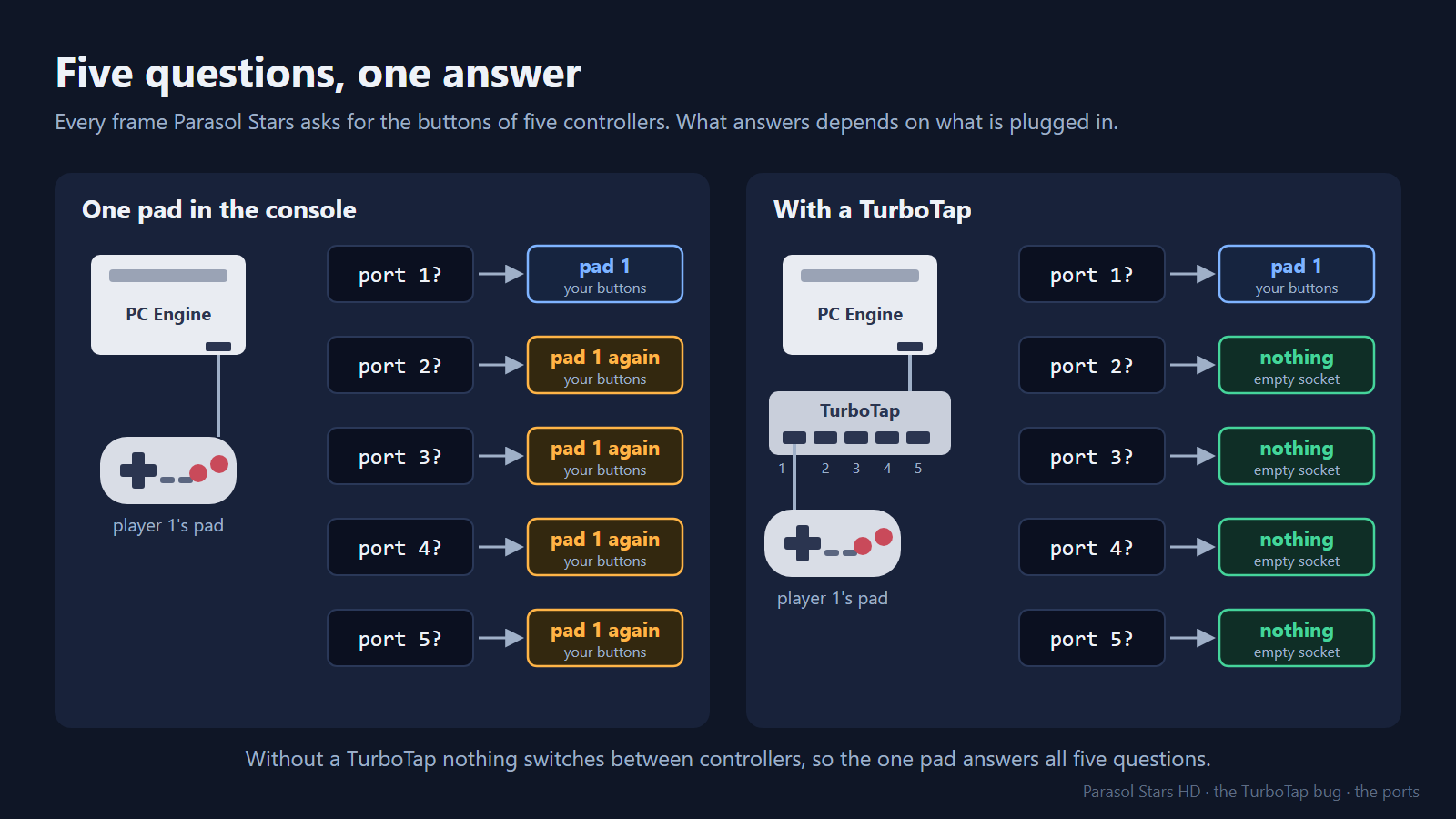
Each home PC Engine and TurboGrafx-16 has one controller port. The game reads
it through a 4-bit register at $1000. Bit 0 (SEL) selects which half of the
pad answers: the four directions or the four buttons. Bit 1 (CLR) is a reset
line.
The TurboTap (NEC’s multitap) connects to that port and has five sockets. A CLR pulse resets it to socket 1. Each change of SEL from 0 to 1 moves it to the next socket. This is how one port reads five controllers. A pad that is connected directly to the console has no sockets to step through. It answers every read.
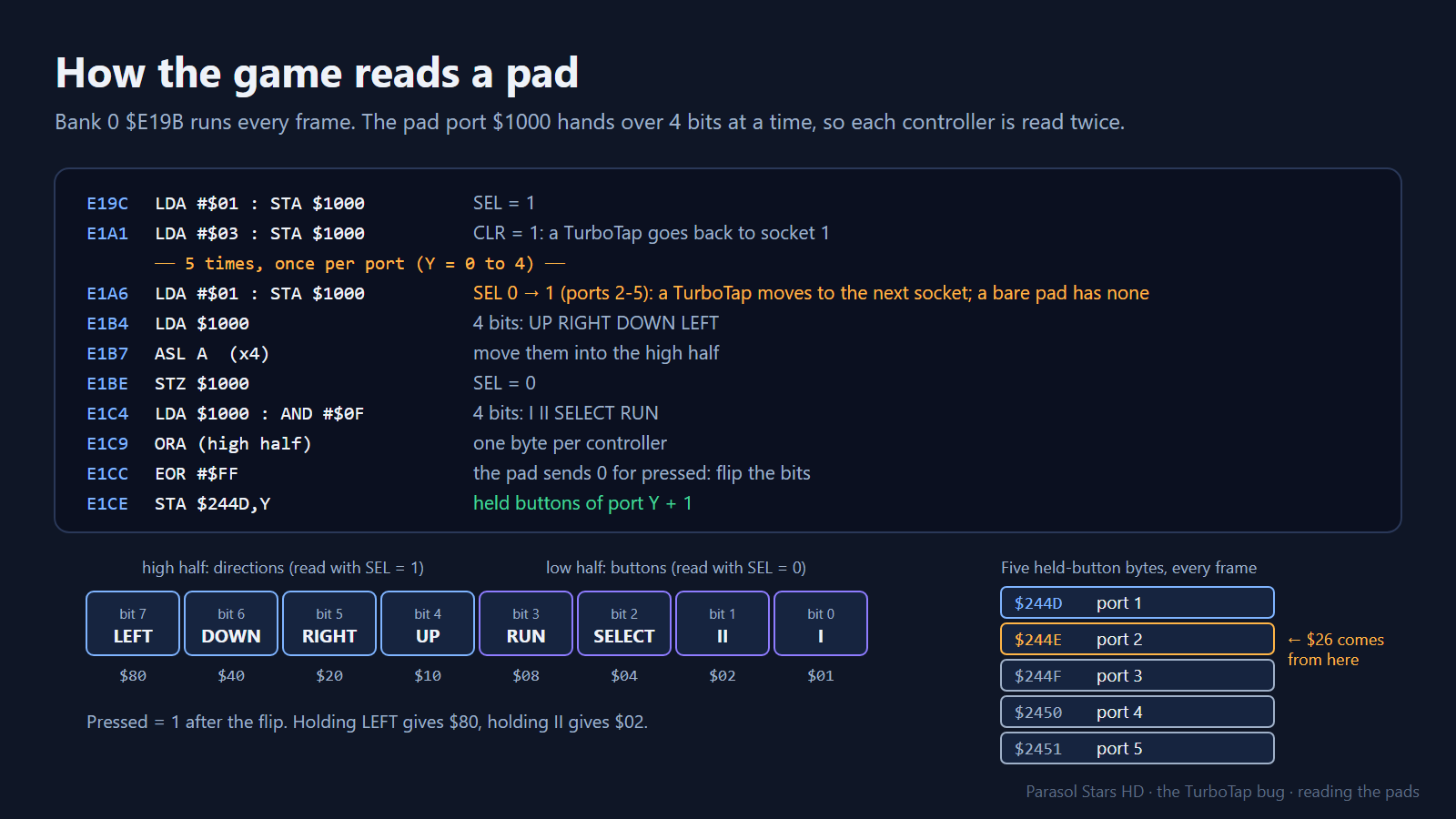
Bank 0 $E19B reads the controllers in every frame. It resets the tap. Then,
for each of the five ports, it reads the directions and the buttons, combines
them into one byte, inverts the byte (the pad sends 0 for pressed), and stores
it. Port 1 goes to $244D and port 5 goes to $2451. The routine does not
check if a TurboTap is present.
So with one pad, ports 2 to 5 hold player 1’s buttons.
How $26 is used
Three routines use the zero-page byte $26 in each frame. (The HuC6280 zero
page is at $2000, so for a watchpoint the address is $2026.)
- Player 1’s routine writes port 1’s held buttons to
$26. - Player 2’s routine writes port 2’s held buttons to
$26. This routine runs in every frame, even when there is no player 2, because it checks if a second player wants to join. - The enemy routines run. The wall tests of the flying enemies (
$6645for movement to the right,$66BCfor movement to the left) read$26as a counter. They read it before they write it.
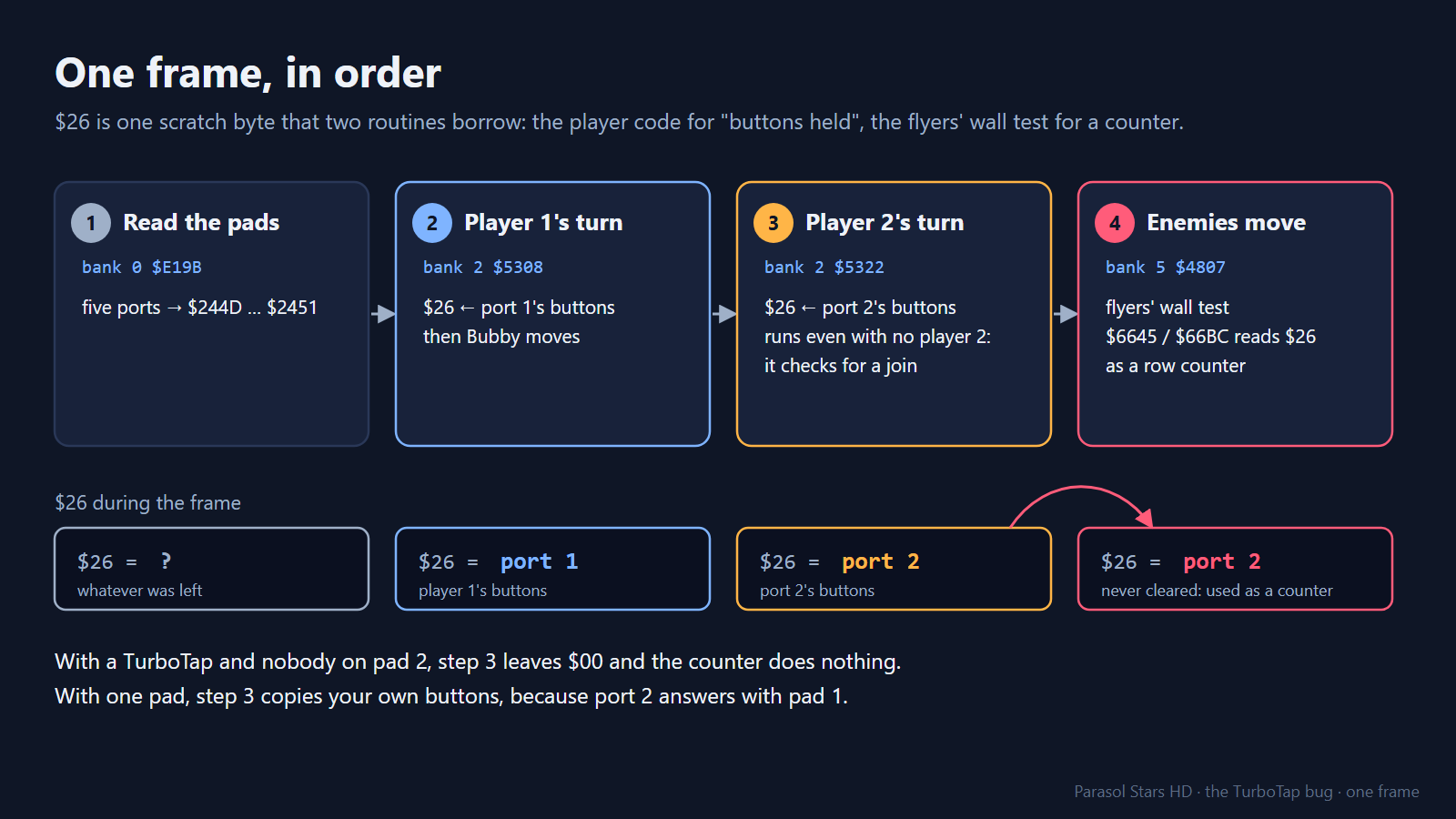
When the enemy routines run, $26 holds port 2’s buttons. With one pad and no
TurboTap, port 2 reports your own buttons. In a two-player game, it reports
player 2’s buttons. The walls work correctly only when port 2 reports no
buttons (for example, a TurboTap with one player).
The wall test
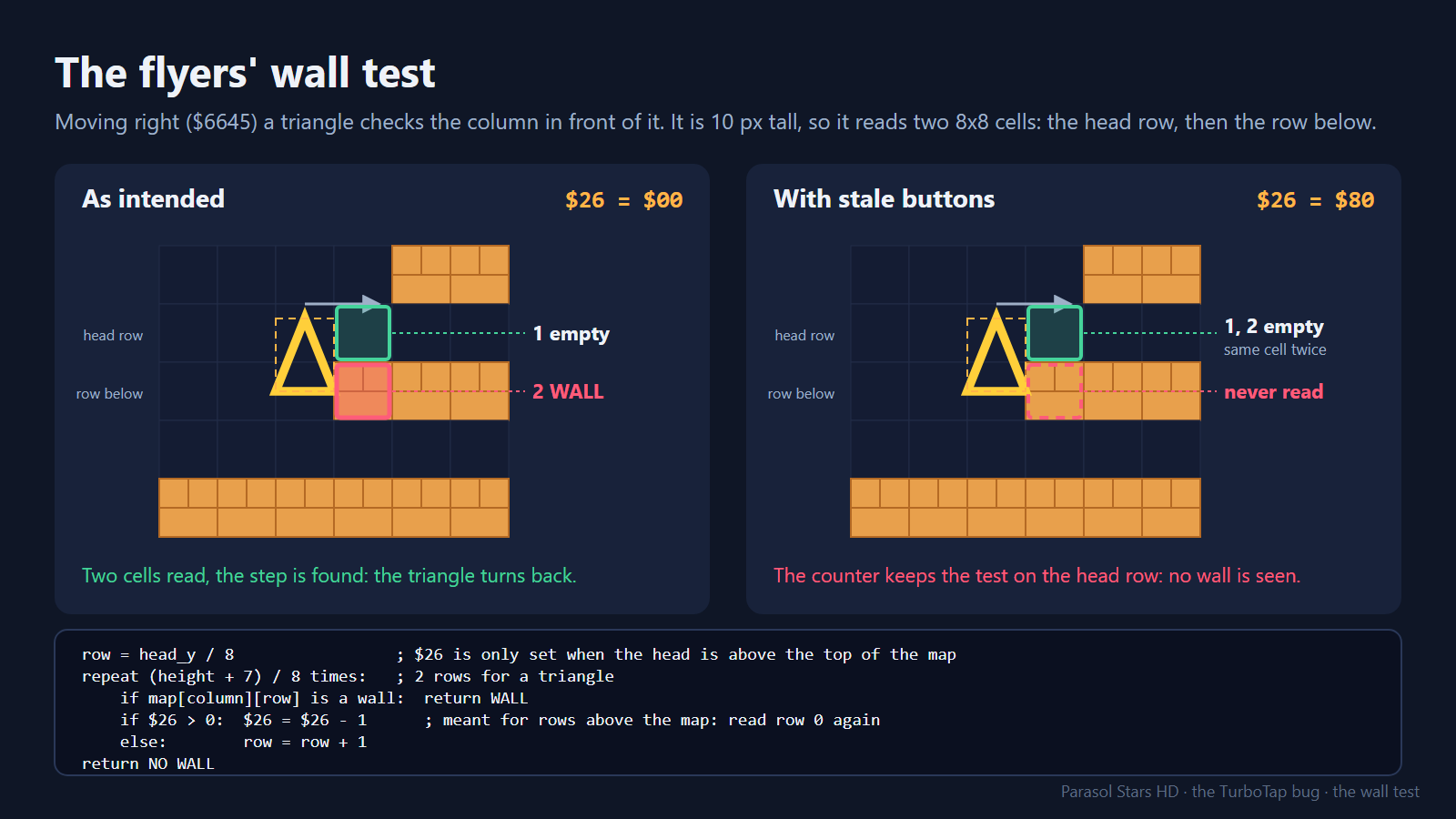
A triangle is 10 pixels high. When it moves, the wall test checks two rows of the 8x8 collision grid in the column in front of it: the row of its head, and the row below.
The counter is for one special case. When the head of a flying enemy is above
the top of the map, the rows above the map do not exist. The routine sets
$26 to the number of missing rows and reads row 0 again for each of them. In
all other cases, the routine does not set $26. It expects $26 to be 0.
row = head_y / 8                 ; $26 is only set when the head is above the map
repeat (height + 7) / 8 times:   ; 2 rows for a triangle
    if map[column][row] is a wall:  return WALL
    if $26 > 0:  $26 = $26 - 1      ; for rows above the map: read row 0 again
    else:        row = row + 1
return NO WALL
If $26 is not 0, the test reads the head row again instead of the next row.
It does not check the row below, so it does not detect a wall that touches
only the lower half of the triangle.
The first frame that differs
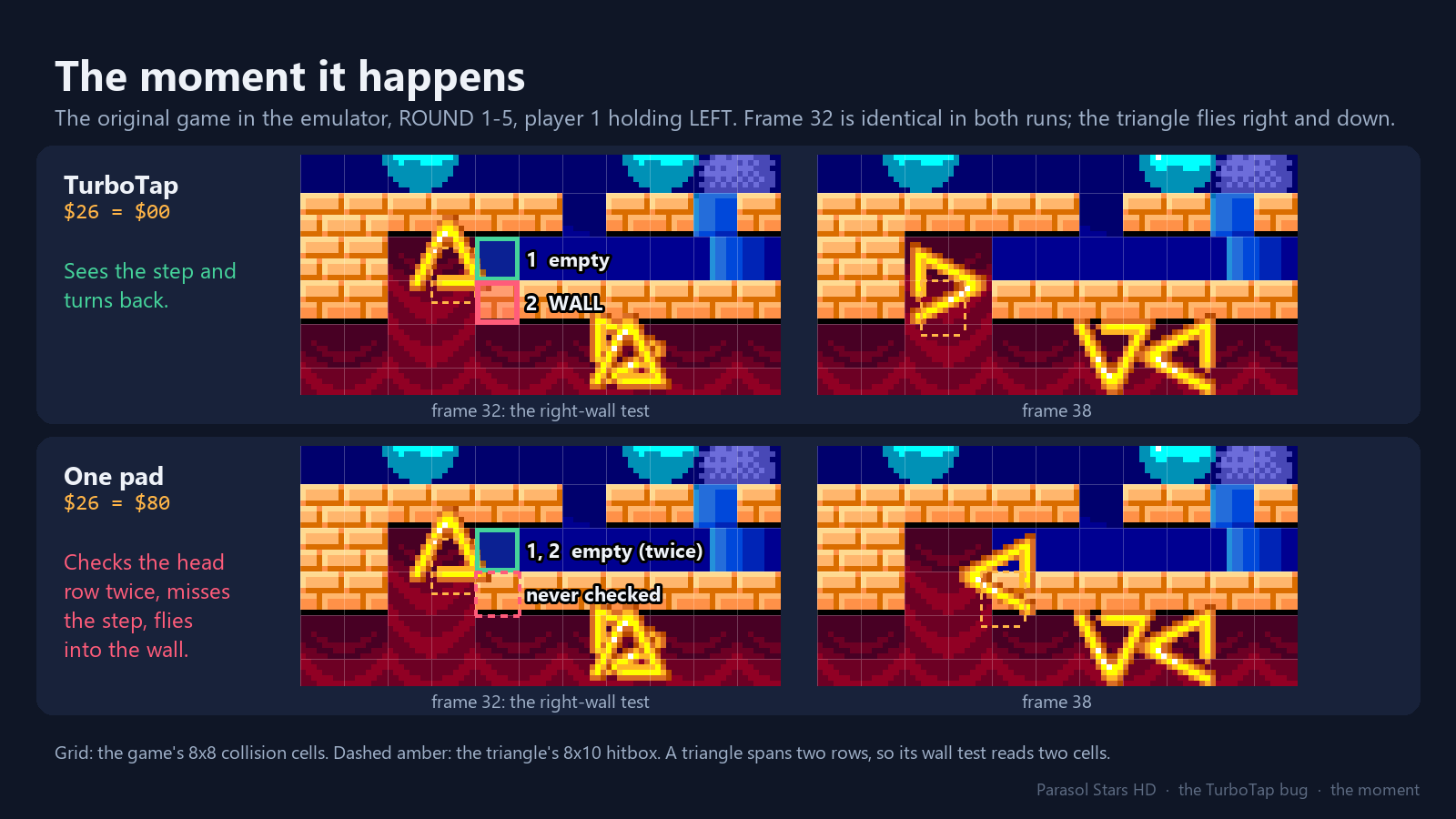
The agent ran the original two times from the same save state with the same input: one time with a TurboTap and one time with one pad. Player 1 holds LEFT. The triangles move the same way in both runs until frame 33.
At frame 32, triangle 5 flies right and down. Its wall test reads column 44. Row 8 (the head) is empty, and row 9 has a step of the maze. With the TurboTap, the test reads both cells, finds the step, and the triangle turns back. With one pad, the test reads row 8 two times, and the triangle flies into the step. Six frames later, it is inside the bricks.
Measurements
All measurements are on the original ROM in the emulator, from the round 1-5 save state:
| Test | TurboTap | One pad |
|---|---|---|
| Player 1 holds LEFT, 4000 frames | 4 of 10 leave for short times; outside the maze 1.8% of the time | 9 of 10 get out; outside the maze 75.5% of the time |
| Random input, 8 seeds | the same short trips, 1.8% | 8 to 10 get out; outside the maze 31-53% of the time |
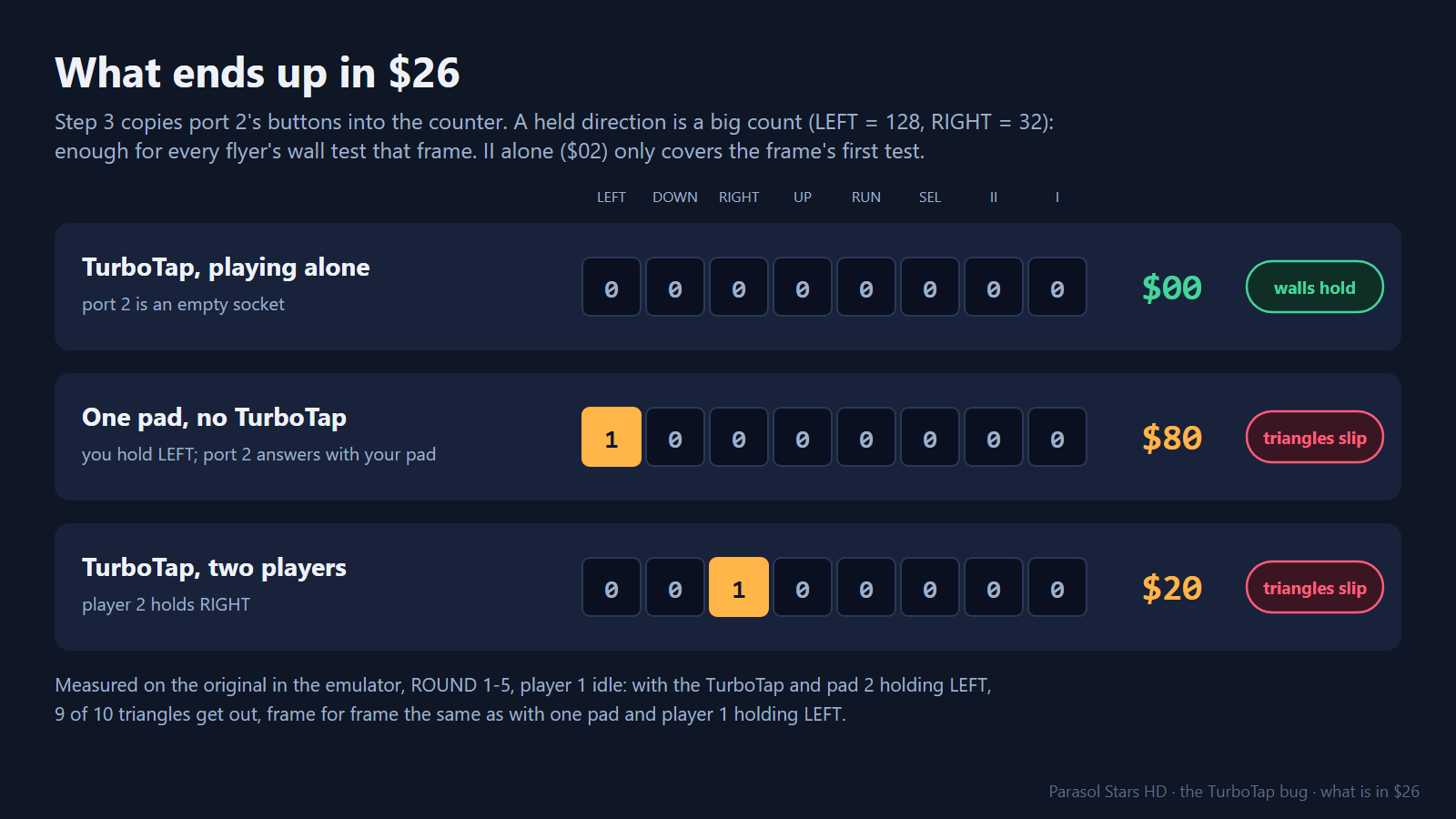
| Player 1 does nothing, pad 2 holds LEFT, 3000 frames | 9 of 10 get out, the same frame for frame as one pad | |
| Random bot, 96 sessions each | 0 deaths in 480,000 frames | 741 deaths in 459,124 frames |
In the first three rows, the harness holds player 1 in one place and makes him
invulnerable, so only the triangles act. The input still goes to the pad, so
$26 still gets it. The bot plays with 9 lives, and a session ends at game
over. This is why the frame totals are different. The 1.8% is the baseline:
the maze has openings, and the triangles go through them for short times even
when $26 is 0.
I also tested a flood after 20 seconds of walking. In the original with the TurboTap, the flood caught all ten triangles. The remake’s one-pad model, which matches the original’s enemy logic frame for frame, caught two. The other eight were already outside the maze.
A second player does not prevent the bug. In the third row, player 1 does not
press anything and pad 2 holds LEFT. The result is the same as with one pad.
In real two-player games (six saved states, including rounds with flying
enemies in other worlds), $26 at the start of the enemy routines always
contains pad 2’s byte.
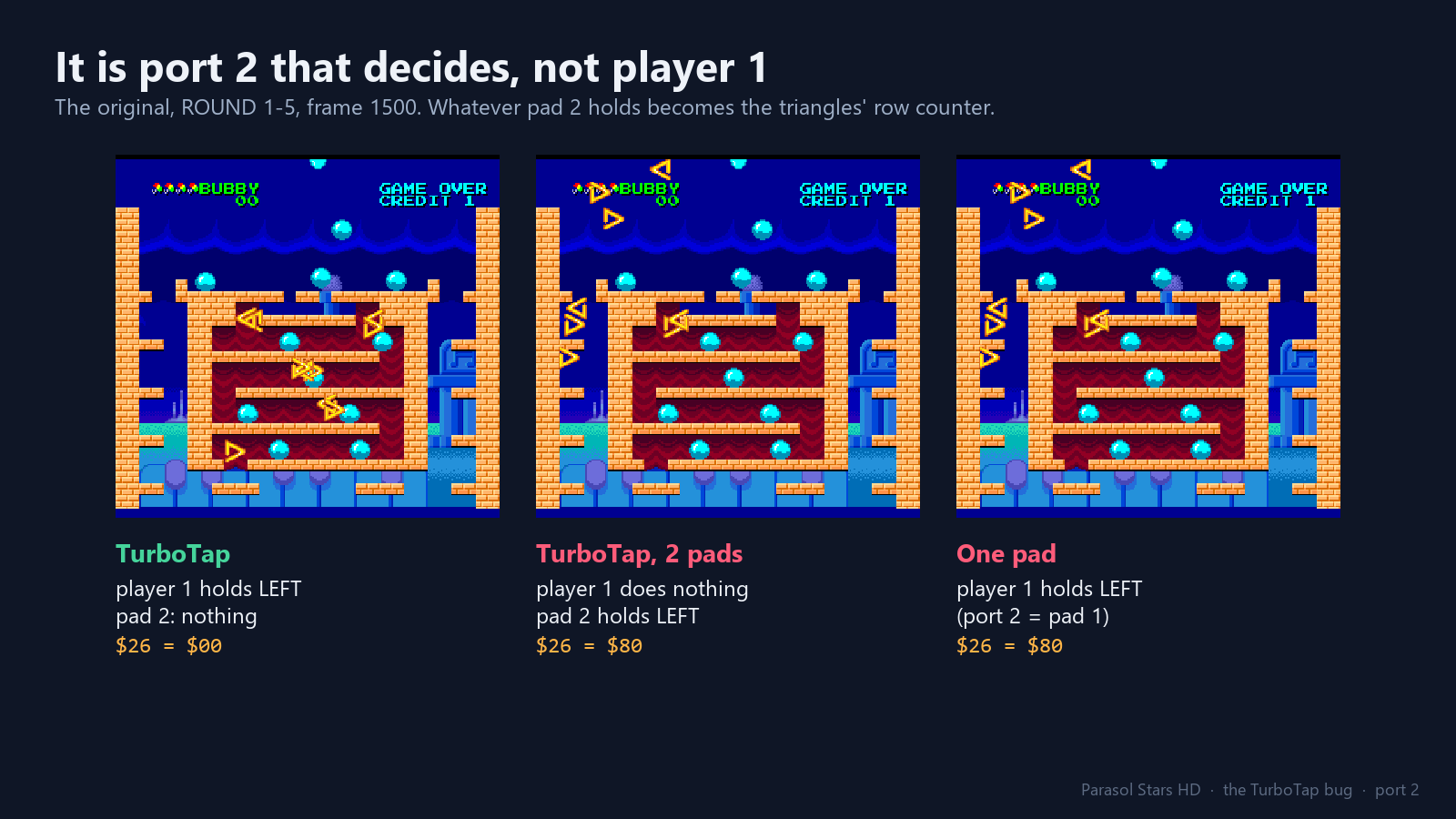
Round 1-5 is not the only round where this happens. The section “The rest of the game” below covers the other rounds.
Why I call it a bug
Three things in the ROM show that the developers did not intend this behavior:
- The counter in the wall test has one purpose: rows above the map. All other paths through the routine expect it to be 0.
- The room is designed to be cleared with a flood. That works only if the triangles stay in the maze.
- On the title screen, bank 0
$E204checks for a TurboTap. It compares the new button presses on ports 1, 2 and 3. If you press RUN on a single pad, the press shows on all three ports, so the game sets its multitap flag$2458to 0 and disables two-player games. The game knows that there is no TurboTap, but the wall test does not use that information.
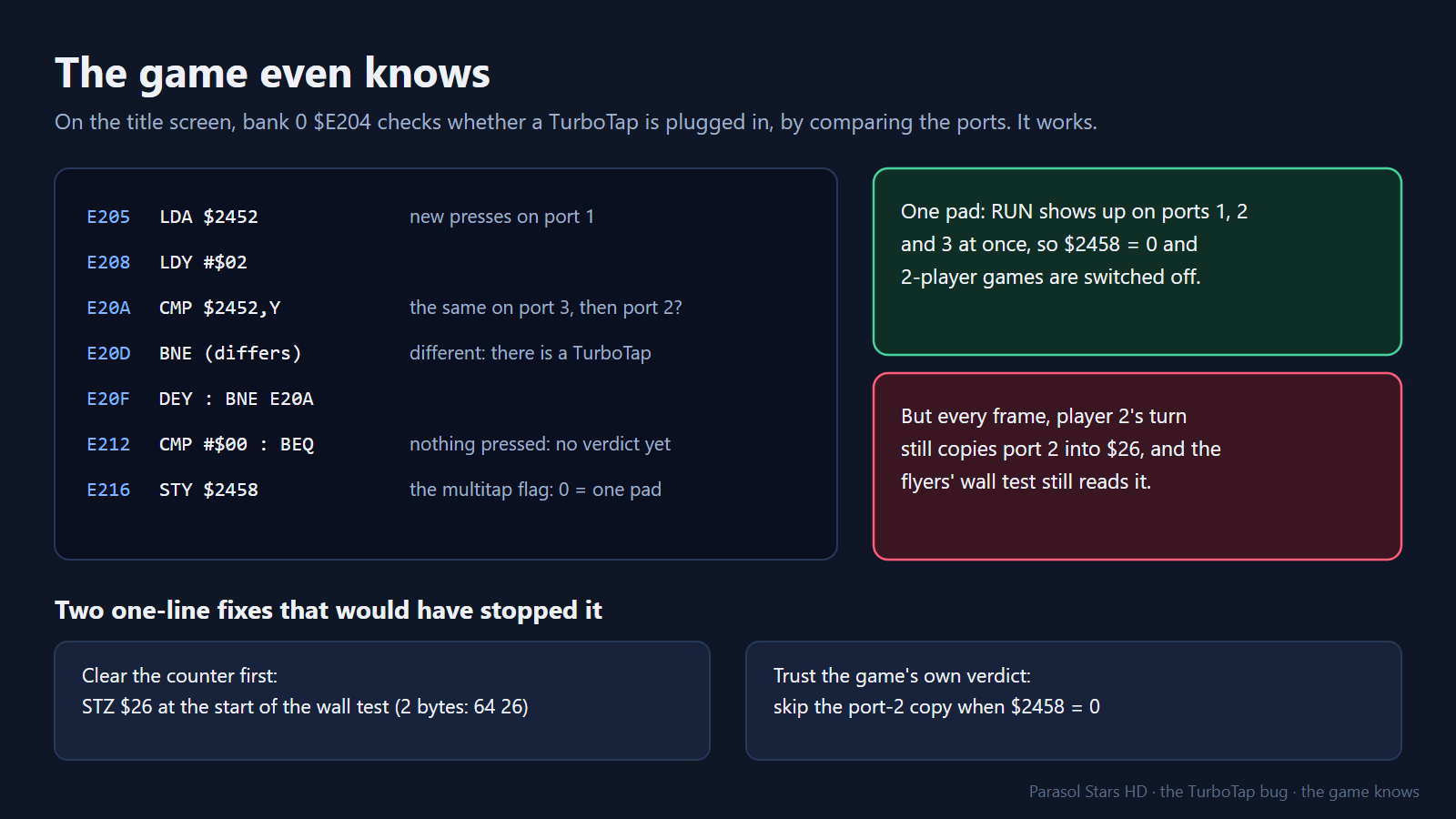
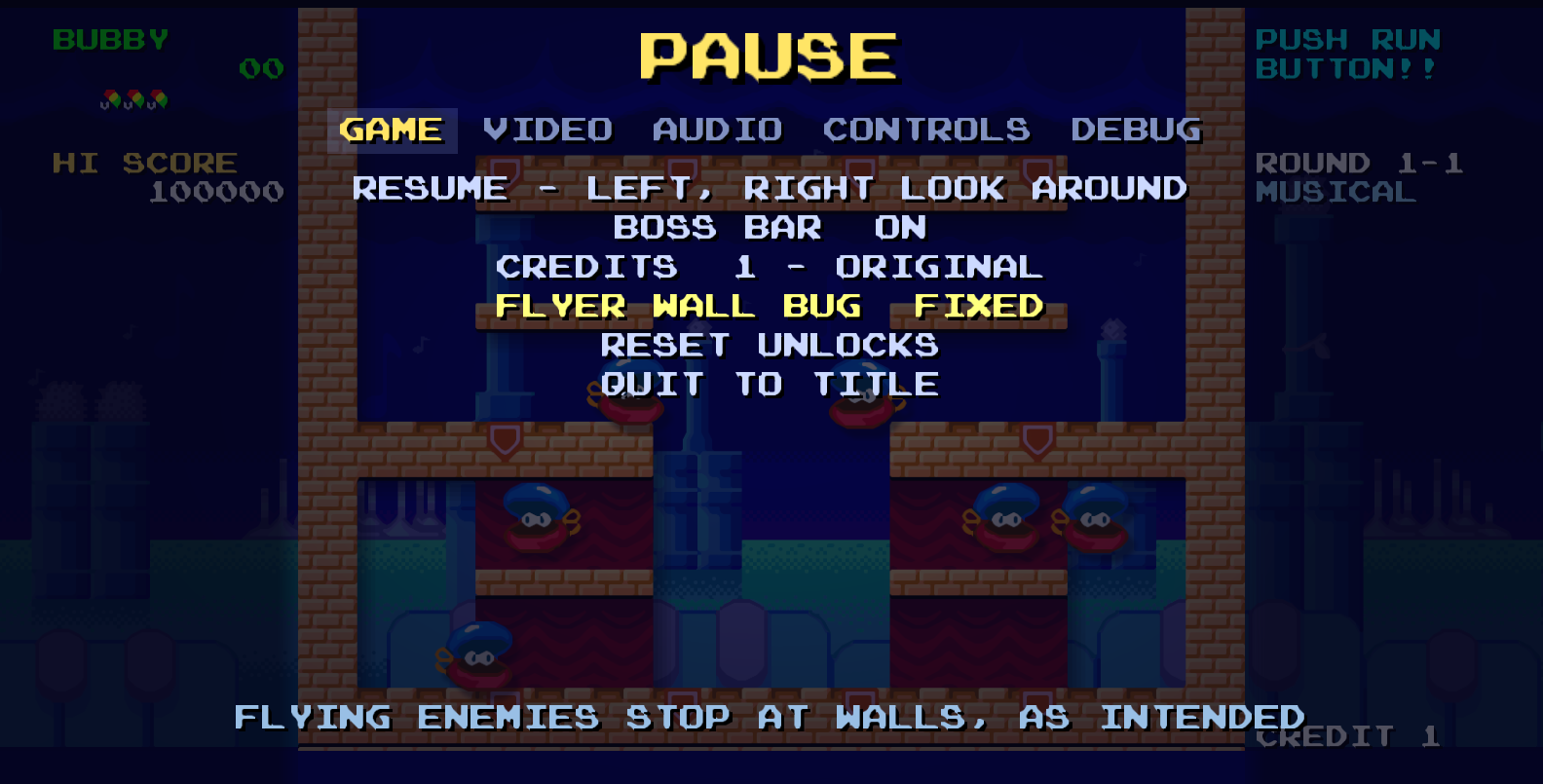
The fix is a two-byte STZ $26 at the start of each wall test. My remake has
a FLYER WALL BUG option in the pause menu. FIXED is the default. ORIGINAL keeps
the shipped behavior: $26 contains your buttons with one pad, and player 2’s
buttons in a two-player game. The regression tests use ORIGINAL, so they still
match the ROM. An option for the controller type would not fix the bug,
because with a TurboTap it still occurs when player 2 holds a direction.
How it probably shipped
This part is a guess. I think the developers tested mostly with a TurboTap
connected. The pce-devel controller notes say that all games were expected to
work with the multitap. With a TurboTap and one player, $26 is $00 when the
enemy routines run, the counter does nothing, and the walls work. To see the
bug, you must play with only the pad that came with the console and hold a
direction in a room with flying enemies. Even then, it looks like the enemies
are just difficult.
My emulator had the same configuration as that guessed test setup. That is why the original looked correct to me and the remake looked wrong.
Is it the emulator?
All the tests ran on the original ROM in an emulator, not on a console. These are the reasons that I think a console behaves the same way:
- The TurboTap protocol is documented: CLR resets it and SEL steps it. I read the emulator’s input code, and it does what the documentation says.
- The game’s title screen check works only because a single pad answers on all
ports. If the console did not do this,
$E204would not see RUN on ports 2 and 3.
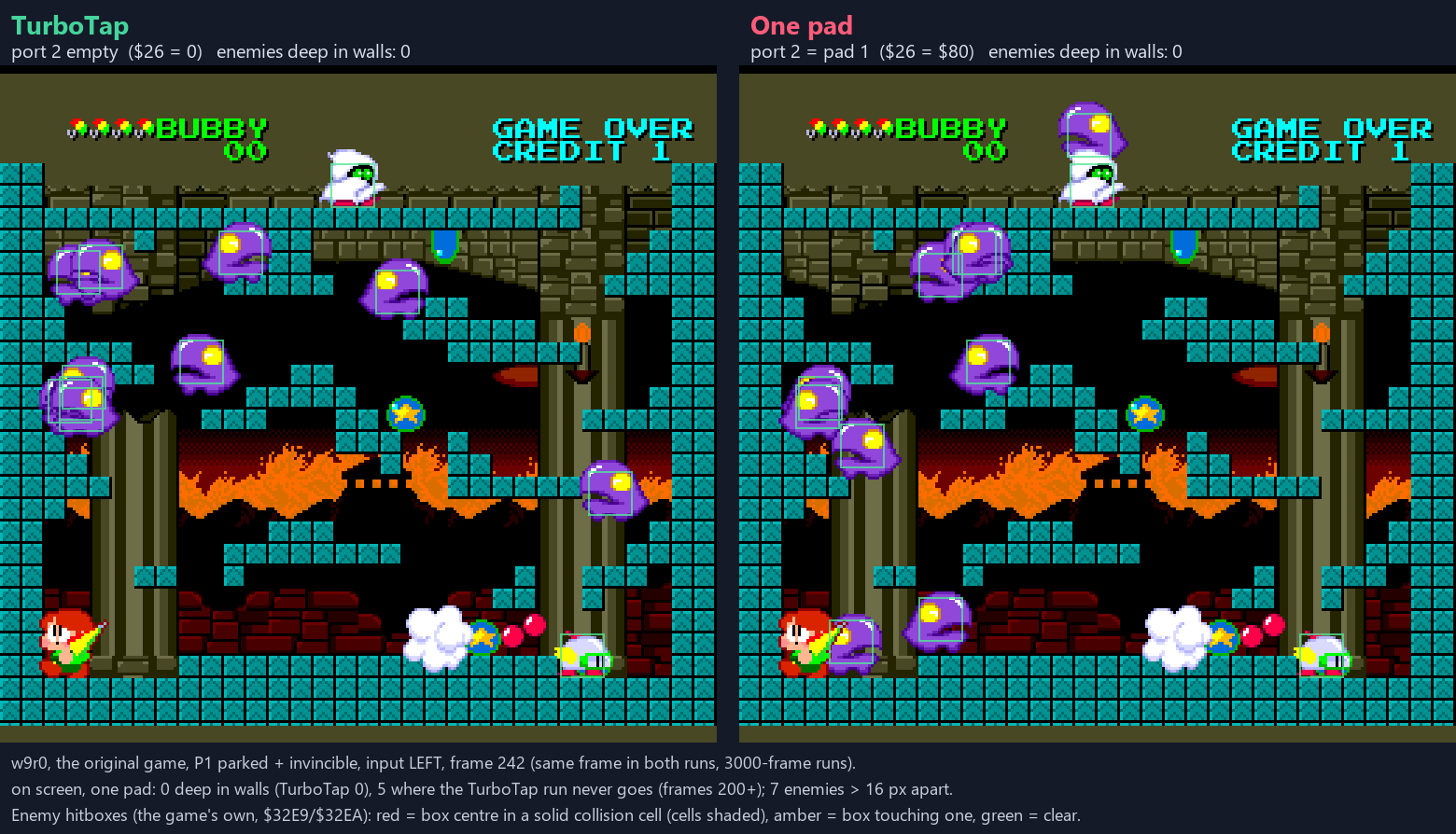
The TurboTap screenshots show GAME OVER / CREDIT 1 for player 2. The save
state has the multitap flag $2458 at 0 (one pad), and the harness enables the
tap after it loads the state. This does not change the result, because the
copy from port 2 does not check that flag.
I did not find this bug described anywhere else. I would like someone to test it on a console. If you have a PC Engine or TurboGrafx-16, one pad and Parasol Stars, go to round 1-5, hold LEFT for 20 seconds, and watch the triangles. You will see some short trips through the maze’s openings even with a TurboTap. With the bug, triangles fly into the bricks.
The rest of the game
Round 1-5 is only where I noticed the bug. The same wall test runs for flying enemies in many rounds, so the next question was where else it changes the game.
The project has a save state for each round of the original, 78 in all. An
agent ran each one twice with the same input, once with a TurboTap and once
with one pad, and logged every read of $26 and $27. With the TurboTap, every
read of the value that player 2’s copy left there was 0. With one pad, the wall
test read the held buttons in 36 of the 78 rounds.
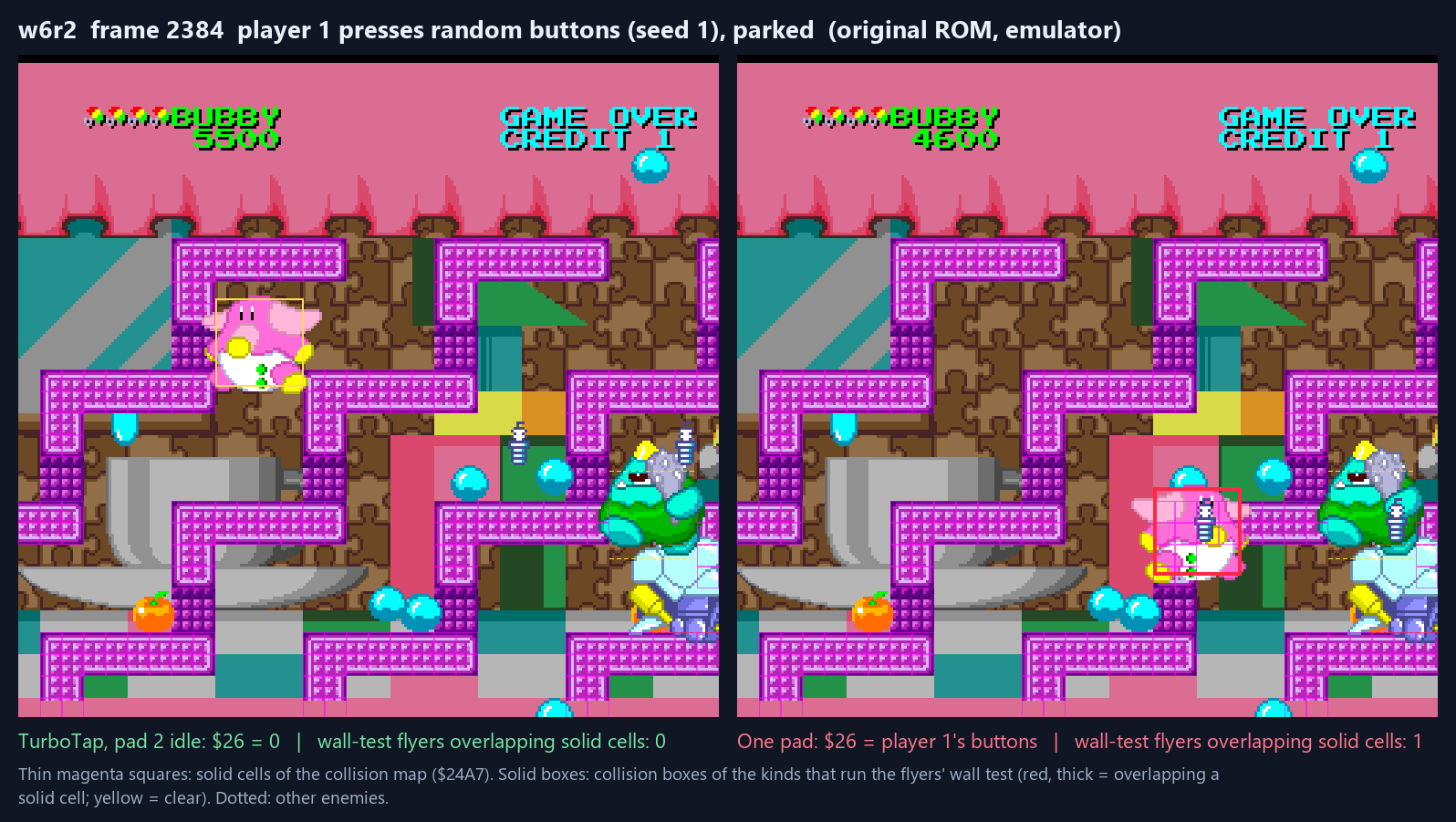
A stale read does not always change what you see. So one group of agents measured each of the 36 rounds: the same save state and input with a TurboTap and with one pad, for 3,000 to 9,000 frames, with A/B screenshots and a count of the frames where a flyer’s hitbox centre is inside a wall. A second group re-ran every measurement with its own scripts and tried to refute each verdict. The verifiers reproduced the measurements, corrected a few descriptions, and changed some verdicts: two rounds went up from subtle to visible, and one went down.
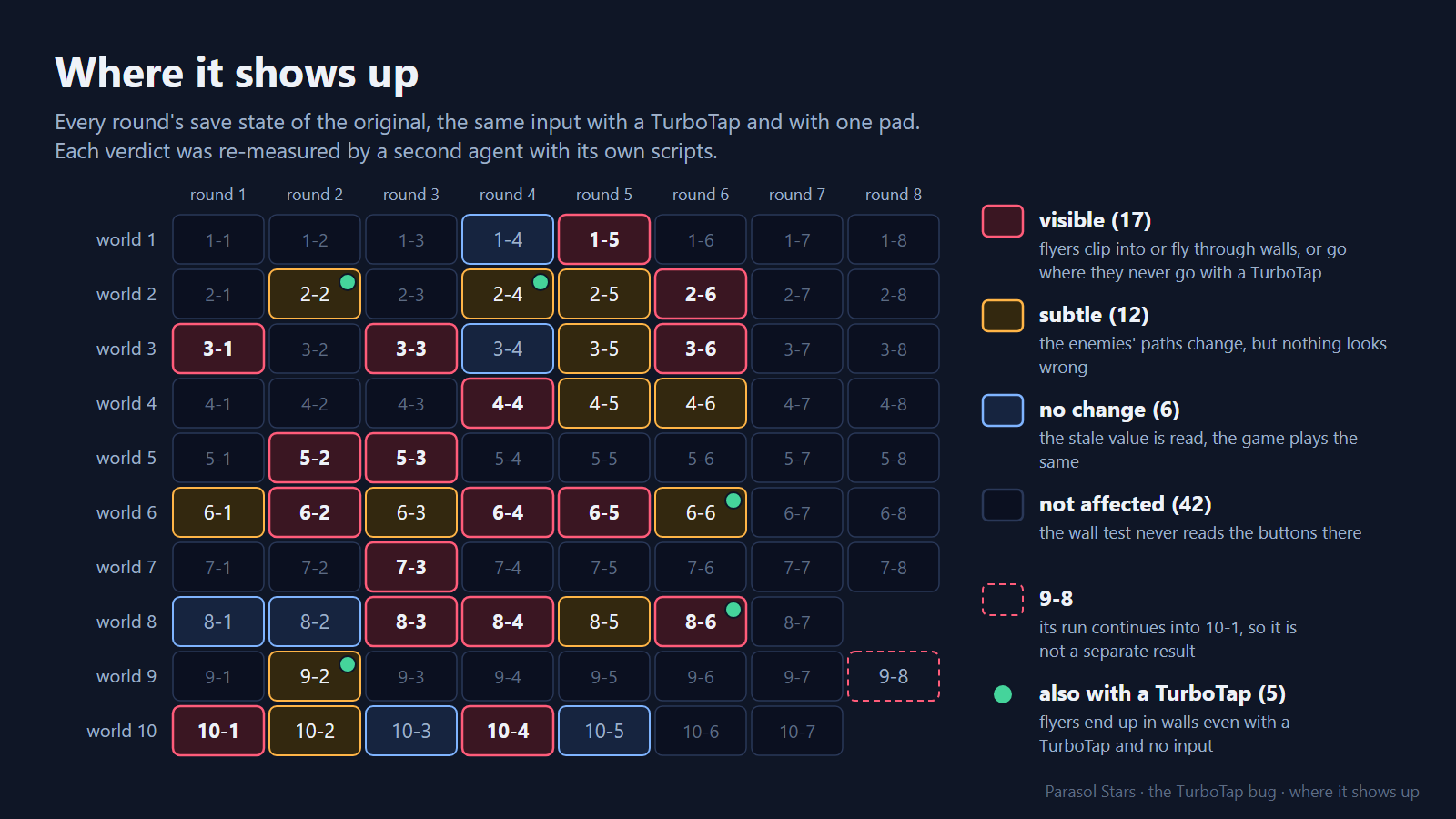
After that check:
- In 17 rounds the difference is visible. Flyers clip into walls or fly through them, or reach places that they never reach with a TurboTap. In some rounds this only happens now and then.
- In 12 rounds the enemies’ paths change, but nothing looks wrong.
- In 6 rounds the game plays the same.
The search found two more things.
The bug is not only about controllers. Even with a TurboTap, a flyer’s wall
test can start with a value that other code left in $26. When a flyer’s head
is above the top of the map, the wall test sets $26 to the number of rows
above the map, and part of that count can stay there after the test ends. The
routine that moves the flyers (bank 6 $6CB6) also leaves values in $26.
Nothing clears the byte between two flyers’ wall tests.
I compared the original with a version that clears $26 at the start of each
wall test, both with a TurboTap and no input, for 9,000 frames. In five rounds, flyers end up inside
walls only in the original: 9-2 (397 frames against 0), 8-6 (149 against 0),
2-2 (109 against 0), 2-4 (38 against 0) and 6-6 (26 against 0). A second agent
checked each case: every time, the flyer had just skipped a wall cell because
of the stale value. These are the green dots on the map.
Player 2’s join check reads $27. On a normal console with one pad, nothing
happens, because the game turns off joining when it does not find a TurboTap on
the title screen. But if a TurboTap was there on the title screen and stops
answering later (unplugged during play, or an emulator’s multitap switched
off), the RUN press that unpauses the game also joins player 2. The credit
goes, Bobby comes in, and pad 1 then moves both characters. I only tested this
in the emulator.
In two-player games, the flyers’ wall test is the only code outside the player routines that reads player 2’s buttons.
This is the part that I could not have done by hand in any reasonable time: 78 rounds, two setups and three inputs, thousands of frames each, and then a second pass to check every result. The agents took a little over an hour for all of it.
The bug class
This bug is an example of a general class. Old consoles keep temporary values
in a small set of fast, shared bytes (the zero page on the 6502 family). One
routine leaves a value in a shared byte. A later routine reads that byte before
it writes it. Here, the player code uses $26 for “buttons held” and the wall
test uses it for “rows to repeat”. The problem shows only in a configuration
that, I think, the developers rarely tested.
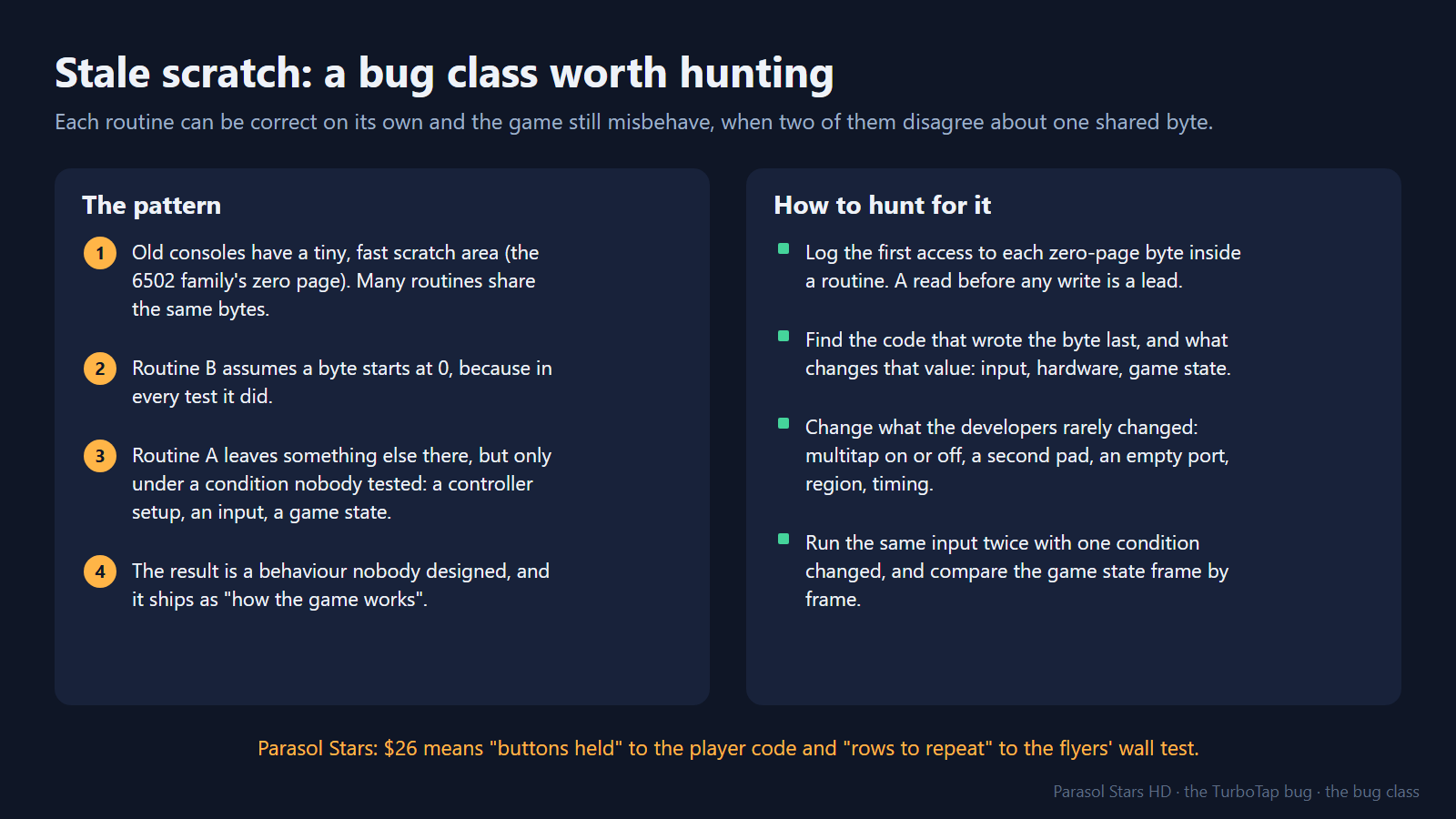
The method to find this class of bug:
- Log the first access to each zero-page byte in each routine. A read before any write is a candidate.
- For each candidate, find the code that wrote the byte last. Then find what changes the value: input, hardware or game state.
- Change the configurations that the developers rarely changed: controller setup, empty ports, region, timing.
- Run the same input two times with one change, and compare the game state frame by frame. Examine the first frame that is different.
What the agent did, and its mistakes
I could have done all of this by hand. It would have been grueling, and it
would have taken a lot of time that I do not have, even for one game, let alone
a whole shelf of them. The agent did that work. It measured the speeds to
remove the first theory. It ran A/B tests with one change at a time. It ran 192
bot sessions (939,124 frames). It found the first frame where the two runs are
different, and it traced $26 back to the routine that wrote it. Being able to
hand that work off and see what it uncovers is very cool.
It also made mistakes:
- An early summary said that with a TurboTap, none of the ten triangles leave the maze. The data shows four triangles that leave for short times, 1.8% of the time.
- A draft of the infographics said that the button you hold does not matter. That was wrong: button II alone gives a count of 2, and the wall test of the first flying enemy uses it up. The draft generalized from tests that did not include that case.
- The one-pad behavior in the remake was the agent’s decision. It kept the behavior of the test harness and did not compare it with my emulator configuration. That made the remake harder than I expected.
- The first sweep script missed some memory accesses, so one routine looked like it read the stale buttons when it did not. A verifying agent found the problem, and the corrected sweep found the same 36 rounds.
We found each mistake when we checked the claim against the logged data.
After that, I had the agent turn the explanation work into a skill. It takes a bug that you understand and makes a set of pictures from the evidence: real frames from the original, and diagrams where each number comes from a measurement.
Then an agent built the search part as a tool. It traces every memory access
in the emulator, finds the reads in each routine that come before a write,
ranks them, and tests the best candidates with A/B runs that change one
condition. As a test, it had to find the $26 bug with no hint. It ranked the
two wall-test reads first and second out of 2,474 candidates, in about 13
seconds. Run over every round, it also found the leftover count described
above.
The tool still makes mistakes. In round 1-5 it marked the player’s state byte as a confirmed problem, but that byte only changed because the escaped triangles hit the player. A person still has to read what it finds.
Outside games
My day job is finding issues in software, mostly not in games, and this is what excites me about it. I see the same kind of bug in large code bases: a value that one part of the code leaves behind and another part trusts, in a configuration that nobody tests. Those code bases are big, strange and full of odd edge cases, and nobody can keep all of their variations in their head. Agents are getting better at taking one systemic cause like this and checking every place where it shows up. Each time that gets better, we find more unintended behavior that has been sitting there for years, and that is exciting.
If you remember this room being very hard on a console with one pad, or if you know of other bugs like this, I would like to hear about it.
Sources: the Lakitu egg behavior is documented on The Cutting Room Floor (summarized by Nintendo Everything). The Street Fighter II cancel story comes from its designers, in Game Developer. The GoldenEye details are from Wikipedia and Nintendo Life. The TimeSplitters 2 story is from Kotaku and Tech Times, and the Alien Resurrection code from Time Extension. The TurboTap protocol and the multitap expectation are from pce-devel’s PCE_Controller_Info. The emulator’s model of the TurboTap is in the input code of Geargrafx. All measurements are from the original ROM in an emulator harness, except the one-pad flood result, which comes from the remake’s model as noted above.
October 2026